
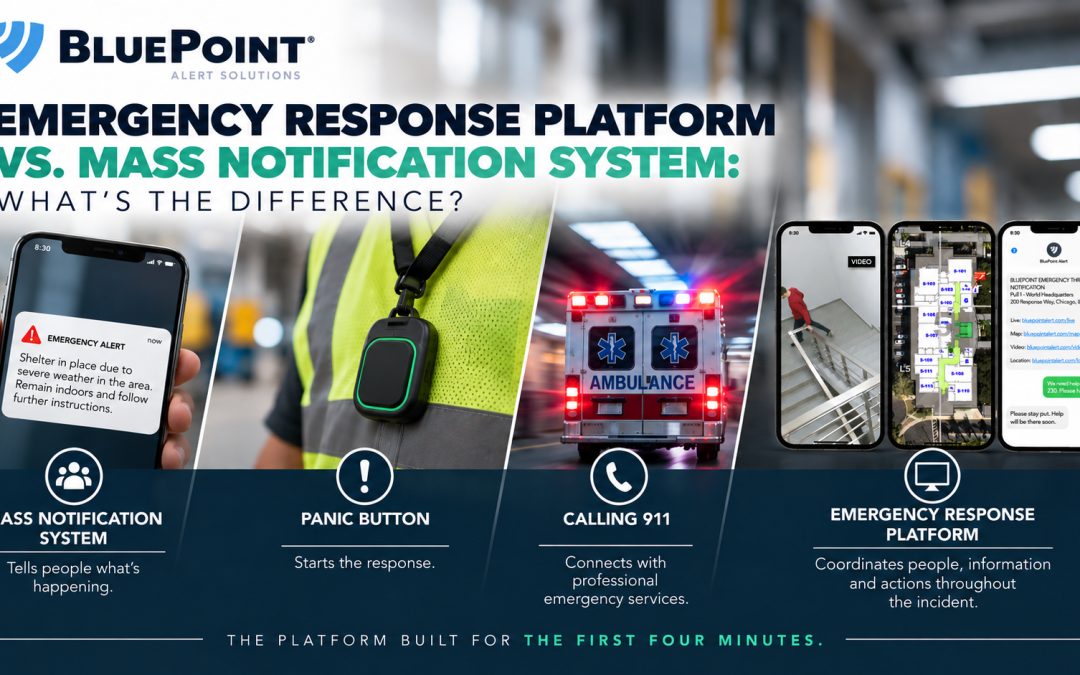
When organizations evaluate emergency technology, terms like mass notification, emergency notification, panic button, emergency communication, and emergency response platform can sound interchangeable.
They aren’t.
Each technology solves a different part of the emergency response problem—and understanding those differences can help organizations identify gaps in their current strategy.
What Is a Mass Notification System?
A mass notification system is primarily designed to distribute information to groups of people during an emergency.
Depending on the system, notifications may be delivered through text messages, emails, mobile applications, phone calls, speakers, desktop alerts, or digital signage.
Its primary purpose is communication:
Something is happening, and people need to know about it.
Mass notification can be an important component of emergency preparedness, particularly when large numbers of people need instructions quickly.
But notification doesn’t necessarily coordinate the response itself.
What Is an Emergency Response Platform?
An emergency response platform goes beyond distributing an alert.
It can connect activation, communication, location information, response teams, incident updates, and command visibility into a shared environment.
Instead of only asking:
How do we tell people an emergency is happening?
An emergency response platform asks:
How do we coordinate what happens next?
What About Panic Buttons?
Panic buttons and emergency pull stations are primarily activation devices.
They provide a fast, recognizable way for someone to initiate an emergency response.
But activating an emergency is only the first step.
After activation:
Who gets notified?
Do responders know exactly where the emergency occurred?
Can safety or security teams communicate?
Can employees receive instructions?
Can leadership see what’s happening?
Can the organization provide useful information to arriving first responders?
Connecting physical activation to a broader response platform can help answer those questions.
What About Calling 911?
Calling 911 remains an essential part of emergency response.
An emergency response platform does not replace 911, police, fire departments, EMS, or professional first responders.
Instead, it addresses another critical part of the emergency timeline: what happens inside the organization while professional responders are being dispatched and traveling to the scene.
During those first few minutes, employees may still need to provide medical assistance, retrieve an AED, evacuate, shelter in place, secure an area, communicate changing conditions, or prepare to meet responders.
The strongest emergency strategies connect internal response with professional emergency services rather than treating them as separate processes.
Notification vs. Response
A useful way to understand the distinction is this:
Mass notification: Tell people what’s happening.
Emergency activation: Start the response.
911: Connect the incident with professional emergency services.
Emergency response platform: Help coordinate people, information, and actions throughout the incident.
Organizations may use several of these technologies together.
The important question is whether they work together to create a coordinated response.
Why Integration Matters
Emergencies rarely unfold exactly as planned.
Information changes. Conditions evolve. Additional resources may be needed.
When emergency technologies operate independently, responders can end up working from different information.
One person may know EMS has been called. Another may not.
Security may know the incident location but employees responding with an AED may have incomplete information.
Leadership may know an emergency occurred but have little visibility into the current response.
An integrated emergency response platform can help create a common operational picture so everyone involved has better situational awareness.
Moving Beyond the Alert
Emergency notification remains important.
But organizations evaluating their emergency preparedness should consider what happens after the notification is sent.
How quickly can people act?
Do they know where to go?
Do response teams receive the same information?
Can they communicate?
Can they adapt as the incident changes?
Those questions define the difference between simply sending an alert and coordinating an emergency response.
BluePoint Alert Solutions — The Platform Built for the First Four Minutes.