
In an emergency, one of the greatest threats isn’t always a lack of information.
It’s uncertainty.
What happened? Where did it happen? Who has been notified? Is someone already responding? Should I evacuate, shelter in place, provide medical assistance, or wait for instructions?
These questions can surface within seconds of an incident. And when answers aren’t immediately available, people hesitate, make assumptions, or begin acting independently.
That is how ambiguity becomes delay.
During the First Four Minutes, organizations don’t need perfect information. They need enough reliable information to make the next decision.
The right technology can help provide it.
Ambiguity Is an Invisible Response-Time Problem
When organizations evaluate emergency response, they often measure time in obvious ways: how quickly an incident was reported, how quickly 911 was contacted, or how quickly professional responders arrived.
But there is another form of delay that is much harder to measure.
The time between knowing something is wrong and knowing enough to act.
An employee witnesses a medical emergency but doesn’t know who else has been notified. A security team receives a report but doesn’t know the exact location. A manager hears that there is an incident but doesn’t know its severity. Multiple employees begin calling different people to determine what is happening.
Every one of these moments introduces friction.
Seconds become minutes—not because people aren’t willing to respond, but because they are trying to establish the basic facts needed to make a decision.
The 40–70 Rule: You Don’t Need 100% Certainty to Act
A useful framework for understanding decision-making under uncertainty is the 40–70 Rule, commonly associated with General Colin Powell.
The concept is simple:
Below 40% information: You probably don’t know enough to make a sound decision. Acting at this stage risks turning assumptions into mistakes.
Between 40% and 70%: You have enough information to make an informed decision while still relying on experience, training, and judgment.
Above 70%: Continuing to wait for more information can become its own risk. By the time you reach 100% certainty, the opportunity to act effectively may have passed.
The lesson is particularly relevant during an emergency.
The goal isn’t perfect information. The goal is actionable information.
In the First Four Minutes, waiting until every detail is known can be just as dangerous as acting without enough information.
The challenge is getting decision-makers into that actionable middle ground as quickly as possible.
Technology Can Help Reach the 40–70% Range Faster
This is where emergency technology can fundamentally change the response process.
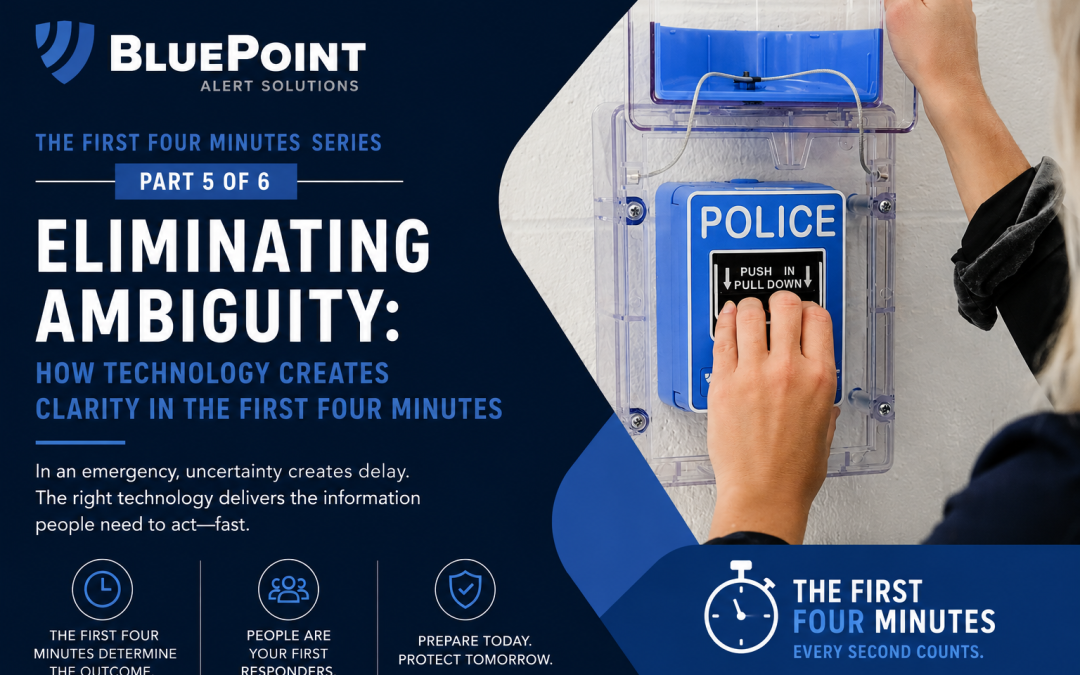
BluePoint Alert is designed to help reduce the ambiguity that consumes the earliest moments of an incident by quickly establishing critical information and connecting the people responsible for acting on it.
An activation can help establish that an incident has occurred. Location information can help establish where. Immediate notifications can help ensure the appropriate people know about it. Real-time communication can allow those people to add context as the incident develops. Command and Control (C2) can give leadership greater visibility into the response underway.
Individually, these pieces of information may not tell you everything. Together, they can help move an organization toward the 40–70% range of actionable information where informed decisions can begin.
That’s an important distinction.
BluePoint isn’t designed to make every decision for an organization or create perfect certainty. It’s designed to help provide the right information, to the right people, fast enough for them to make the decision.
More Information Doesn’t Always Mean More Clarity
Today’s organizations have more communication technology than ever.
Phones. Radios. Text messages. Email. Mass notification systems. Security platforms. Cameras. Access control systems.
Each can serve an important purpose. But having multiple communication tools doesn’t necessarily create a coordinated response. In fact, disconnected systems can create another problem: multiple versions of the same event.
One employee has information from a text. Another hears something over a radio. A manager receives a phone call. Security sees something different on camera. Everyone has information.
But no one has the same information.
The goal of emergency technology should not simply be to distribute more information. It should be to create a shared understanding of the incident.
From “Something Happened” to “Here’s What We Know”
The first moments of an emergency are rarely complete or orderly. Technology can’t eliminate that reality. What it can do is shorten the time required to move from uncertainty to understanding.
Effective emergency response technology should help answer critical questions:
- Where is the incident?
- What type of incident has been reported?
- Who has been alerted?
- Who is responding?
- What actions are already underway?
- How is the situation changing?
Decision-makers may not immediately have 100% of the answers. They don’t necessarily need them. They need enough verified information to understand the situation, apply their training and experience, and make the next decision. The faster a team establishes that shared operating picture, the faster it can move from investigating the incident to managing it.
One Incident. One Shared Picture.
Consider a medical emergency inside a large facility.
Without a coordinated system, someone discovers the emergency and calls for help. Another employee searches for a supervisor. Someone calls 911. A manager begins contacting members of the safety team. Another employee is sent to locate an AED. Everyone may be doing the right thing. But nobody necessarily knows what everyone else is doing.
Now consider the same incident when technology immediately connects the people responsible for response.
The incident is activated. The location is identified. The appropriate people are notified simultaneously. Responders can communicate as the situation develops. Leadership can see that action is already underway. Professional emergency services can be contacted according to the organization’s established protocols. The organization may still not know everything about the incident. But it knows enough to begin coordinating an effective response.
Technology hasn’t replaced people.
It has removed ambiguity between them.
Technology Should Reduce Cognitive Load
Emergencies place extraordinary demands on the human brain. People are processing unfamiliar information while simultaneously trying to make decisions under stress. This is exactly the wrong moment to introduce additional complexity.
Employees shouldn’t have to remember complicated communication trees. Managers shouldn’t have to determine which five people need to be called. Response teams shouldn’t have to piece together information from multiple disconnected channels.
Good emergency technology should make the next action easier—not create another task.
That means designing systems around simplicity:
Activate. Notify. Communicate. Coordinate.
The fewer decisions people have to make about how to communicate, the more attention they can devote to how to respond.
Technology Does Not Replace the Emergency Action Plan
Technology alone isn’t preparedness.
An organization still needs an Emergency Action Plan. Employees still need training. Roles still need to be established. Procedures still need to be practiced.
Technology should reinforce those systems. The Emergency Action Plan defines what should happen. Training gives people the knowledge and instinct to respond. Technology provides information and communication to help them execute. This is where the 40–70 Rule becomes especially relevant. Technology can help provide the information. Training and experience help people interpret it. The Emergency Action Plan provides the framework for acting on it.
Together, they can dramatically reduce the gap between incident and coordinated response.
Turning Information Into Command and Control
This is the distinction between notification and true emergency coordination.
A notification tells people something happened.
Command and control helps people understand what is known, what is happening, and what needs to happen next. BluePoint Alert’s Command and Control (C2) platform was designed around this reality.
Rather than relying solely on fragmented calls, texts, and communication chains, BluePoint helps create a centralized environment for emergency activation, communication, and coordination.
The objective is simple:
Get decision-makers from uncertainty to actionable information as quickly as possible.
Because during an emergency, information has value only when it improves a decision.
You Can’t Wait for 100%
Professional responders remain essential to emergency outcomes.
But before police, fire, or EMS can physically arrive, the people already at the facility must navigate the earliest and often most ambiguous moments of an incident.
They may never have 100% certainty during those First Four Minutes.
And that’s the point.
Effective emergency response isn’t about waiting until every question has been answered. It’s about having enough reliable information to make the best possible decision at that moment—and then continuing to adapt as new information becomes available.
The organizations best prepared for emergencies will not necessarily be those with the most technology. They will be the ones whose technology helps eliminate uncertainty, simplify decisions, and give people a shared understanding of what is happening.
Get enough information. Make the decision. Act. Adapt.
Because in the First Four Minutes, waiting for certainty can become a decision of its own.