
Every organization hopes an emergency never happens.
But hope is not a strategy.
That’s why the Occupational Safety and Health Administration (OSHA) requires many employers to establish an Emergency Action Plan (EAP). An effective EAP provides the framework employees need to respond to fires, medical emergencies, workplace violence, chemical releases, severe weather, and other unexpected events.
For many organizations, creating an EAP satisfies a compliance requirement.
The organizations that are truly prepared see it differently.
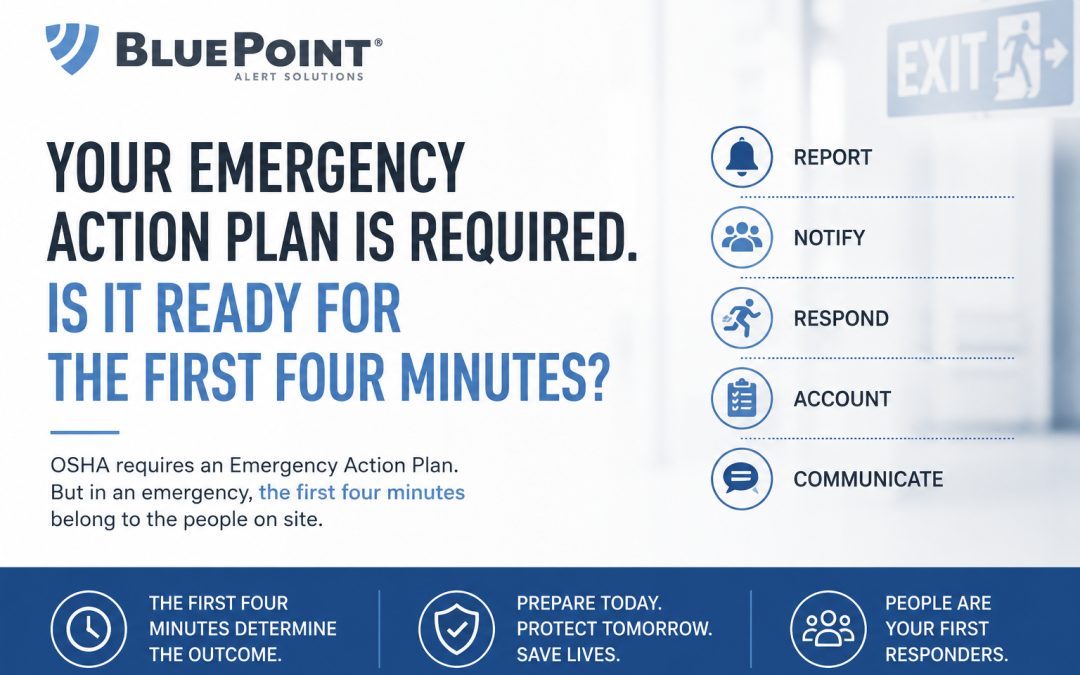
They recognize that an Emergency Action Plan isn’t simply a document to keep on file. It’s a blueprint for what happens during the most critical moments of an emergency—especially the First Four Minutes.
What OSHA Requires
OSHA’s Emergency Action Plan standard establishes minimum requirements for emergency preparedness in the workplace.
A compliant Emergency Action Plan typically addresses:
- Procedures for reporting an emergency
- Emergency evacuation routes and exit procedures
- Methods for accounting for employees after evacuation
- Roles and responsibilities for employees performing critical operations
- Rescue and medical responsibilities, when applicable
- Contact information and communication procedures
- Employee training and periodic review of the plan
These elements form the foundation of workplace preparedness.
But a written plan alone doesn’t guarantee an effective response.
Compliance Is the Starting Point—Not the Finish Line
Many organizations have an Emergency Action Plan because regulations require one.
The more important question is:
Will your plan actually work when an emergency unfolds?
During a real incident, employees aren’t thinking about regulatory requirements.
They’re asking questions like:
- What just happened?
- Who has already been notified?
- What should I do?
- Where should I go?
- Who is in charge?
If those answers aren’t immediately available, uncertainty spreads faster than information.
That’s when valuable time is lost.
The First Four Minutes Expose Every Weakness
Emergency Action Plans often look excellent on paper.
But emergencies don’t happen on paper.
They happen in busy offices, manufacturing facilities, warehouses, schools, healthcare campuses, and places of worship—where information is incomplete and conditions change by the second.
The First Four Minutes reveal whether an organization’s plan is practical or merely procedural.
Can an employee report an emergency immediately?
Can the appropriate people be notified without delay?
Can leaders quickly understand what is happening?
Can responders coordinate their actions instead of working independently?
Those questions aren’t answered by documentation.
They’re answered by execution.
Every Employee Plays a Role
An Emergency Action Plan isn’t just for security teams or facility managers.
It exists for every employee.
In those first moments of an emergency:
An employee may discover a medical emergency.
A supervisor may initiate protective actions.
A maintenance technician may guide an evacuation.
A nurse may begin lifesaving care.
These individuals become the organization’s first responders long before outside help arrives.
An effective Emergency Action Plan empowers them to act with confidence rather than hesitation.
Planning for Communication, Not Just Procedures
Many Emergency Action Plans emphasize evacuation routes and emergency contacts.
Those elements are essential.
But today’s organizations also need to consider something equally important:
How will people communicate during the emergency?
The speed and accuracy of information often determine how effectively teams respond.
Organizations should ask:
- How are emergencies activated?
- How quickly are the right people informed?
- How is situational awareness shared?
- How are response efforts coordinated?
- How are updates communicated as conditions change?
When communication is delayed or fragmented, even a well-written Emergency Action Plan can begin to break down.
Technology Brings the Plan to Life
An Emergency Action Plan defines what should happen.
Technology helps make it happen.
The right emergency response platform like BluePoint Alert supports the plan by:
- Allowing immediate emergency activation
- Automatically notifying predefined response teams
- Providing real-time visibility into developing incidents
- Coordinating communication across departments
- Supporting leadership with shared situational awareness
Rather than replacing an Emergency Action Plan, technology strengthens it by making execution faster, clearer, and more consistent.
Preparedness Is More Than a Binder on a Shelf
Emergency planning should never end once the document is completed.
Plans should be reviewed regularly.
Employees should practice them.
Leadership should evaluate whether the plan reflects how people actually work—not simply how procedures are written.
Preparedness is a continuous process of training, testing, improving, and refining.
Because emergencies evolve.
Your Emergency Action Plan should evolve with them.
The Cost of Waiting
When organizations think about emergency preparedness, they often focus on the cost of implementing a plan or investing in new technology.
A better question is:
What does waiting actually cost?
The financial consequences of a delayed or ineffective emergency response can be significant:
- OSHA serious violations can result in fines of up to $16,550 per violation (2025 OSHA Penalty Schedule).
- The average workers’ compensation claim costs between $44,000 and $50,000, according to the National Safety Council.
- The average cost of a workplace fatality is approximately $1.22 million, also reported by the National Safety Council.
These numbers only tell part of the story.
They don’t account for operational downtime, lost productivity, legal expenses, reputational damage, employee morale, or the lasting emotional impact on coworkers and families.
The goal of an Emergency Action Plan isn’t simply to avoid penalties or reduce claims.
It’s to create an environment where emergencies are recognized quickly, communicated clearly, and managed effectively before they escalate.
Every second saved during the First Four Minutes has the potential to reduce both human and financial consequences.
Owning the First Four Minutes
OSHA requires organizations to establish an Emergency Action Plan because preparation saves lives. But the value of a well-executed plan extends far beyond compliance.
Every minute of delay increases risk—not only to the people involved, but also to the organization’s operations, finances, and reputation.
The First Four Minutes are where every Emergency Action Plan is truly tested. Organizations that prepare for those moments don’t simply meet a regulatory requirement—they protect lives, reduce risk, and strengthen their resilience when every second counts.