
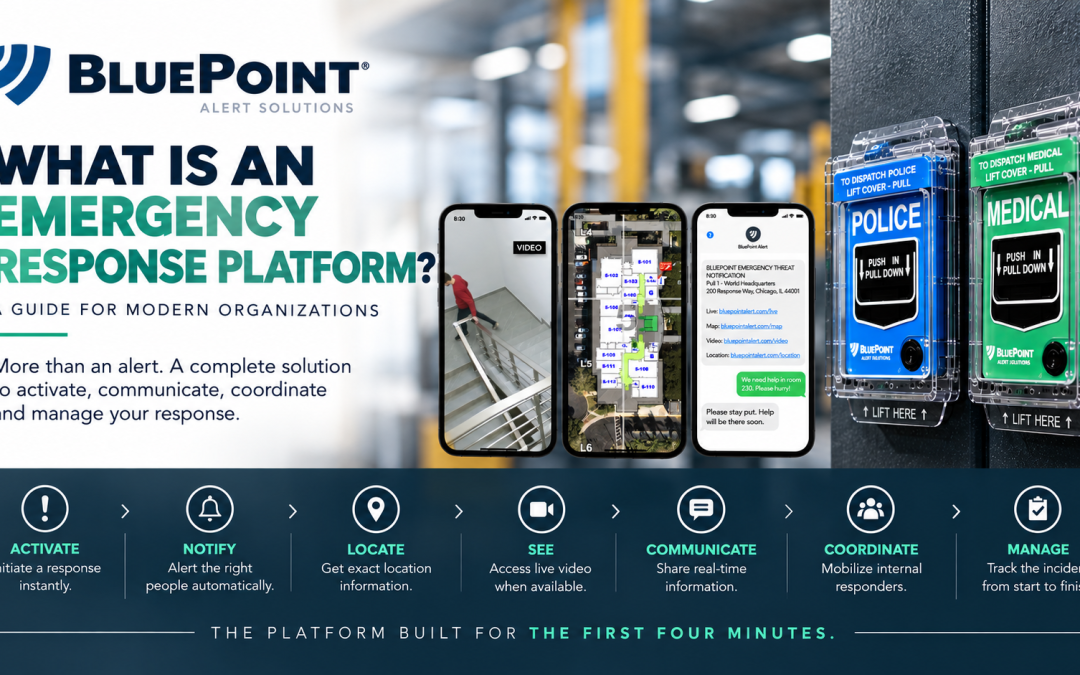
When an emergency happens, sending an alert is only the beginning.
Organizations also need to know what happened, where it happened, who needs to respond, and what actions need to happen next.
That is the role of an emergency response platform.
Unlike traditional systems focused primarily on sending notifications, an emergency response platform helps organizations activate, communicate, coordinate, and manage their response to an incident in real time.
What Is an Emergency Response Platform?
An emergency response platform is a centralized system that helps an organization initiate and coordinate its response from the moment an emergency occurs.
Depending on the platform, capabilities may include:
- Emergency activation
- Automated notifications
- Location information
- Mobile alerts
- Two-way communication
- Defined response groups
- Incident updates
- Situational awareness
- Command-and-control functionality
- Integration with physical emergency devices
The goal isn’t simply to tell people that something happened.
It’s to help the right people take the right action as quickly as possible.
Why Emergency Response Often Becomes Fragmented
Most organizations already have multiple emergency tools: 911, radios, security systems, fire alarms, AEDs, panic buttons, mobile phones, mass notification systems, and Emergency Action Plans.
The problem is that these tools may operate independently.
Consider a medical emergency on a manufacturing floor.
Someone calls 911. Another employee runs for an AED. A supervisor radios the safety team. Someone contacts security. Employees nearby need instructions, and someone needs to direct EMS to the correct entrance.
Every action may be appropriate, but without a shared source of information, the overall response can quickly become fragmented.
An emergency response platform helps connect those actions and create a more coordinated response.
The First Four Minutes
BluePoint Alert refers to the critical period immediately following an emergency as the First Four Minutes.
It’s the time between the moment an incident begins and when professional responders are able to take control at the scene.
During that period, employees, security personnel, safety teams, managers, and bystanders may be the only people physically available to act.
They may need to identify the emergency, activate the response, locate the incident, notify internal responders, retrieve emergency equipment, communicate instructions, and prepare for arriving police, fire, or EMS.
An effective emergency response platform should be designed around this reality:
Response begins at the point of incident—not when first responders arrive.
What Types of Emergencies Can a Response Platform Support?
Emergency response platforms can support a wide variety of incidents, including:
- Medical emergencies
- Cardiac arrest
- Workplace injuries
- Active threats
- Workplace violence
- Security incidents
- Severe weather
- Fires
- Hazardous material incidents
- Lone-worker emergencies
- Facility emergencies
The specific workflow may change, but the fundamental need remains the same: get reliable information to the right people quickly enough for them to act.
Who Uses Emergency Response Platforms?
Emergency response platforms can benefit organizations responsible for employees, visitors, students, patients, customers, or members of the public.
Common applications include manufacturing facilities, warehouses and distribution centers, corporate campuses, schools and universities, healthcare facilities, government buildings, houses of worship, and other large or distributed properties.
For industrial environments in particular, emergency communication can be difficult because employees may be spread across large facilities with loud equipment, restricted work areas, multiple entrances, and limited visibility between departments.
A centralized response platform can help bridge those gaps.
From Alerting to Responding
For years, much of emergency technology has focused on one objective:
Send the alert faster.
That’s important—but it’s only part of the response.
Modern organizations also need technology that helps people understand what’s happening, determine where help is needed, coordinate the appropriate response, and communicate as conditions change.
That’s the shift from emergency notification to coordinated emergency response.
BluePoint Alert Solutions was built around that critical window between the moment an emergency begins and professional responders arrive.
The Platform Built for the First Four Minutes.